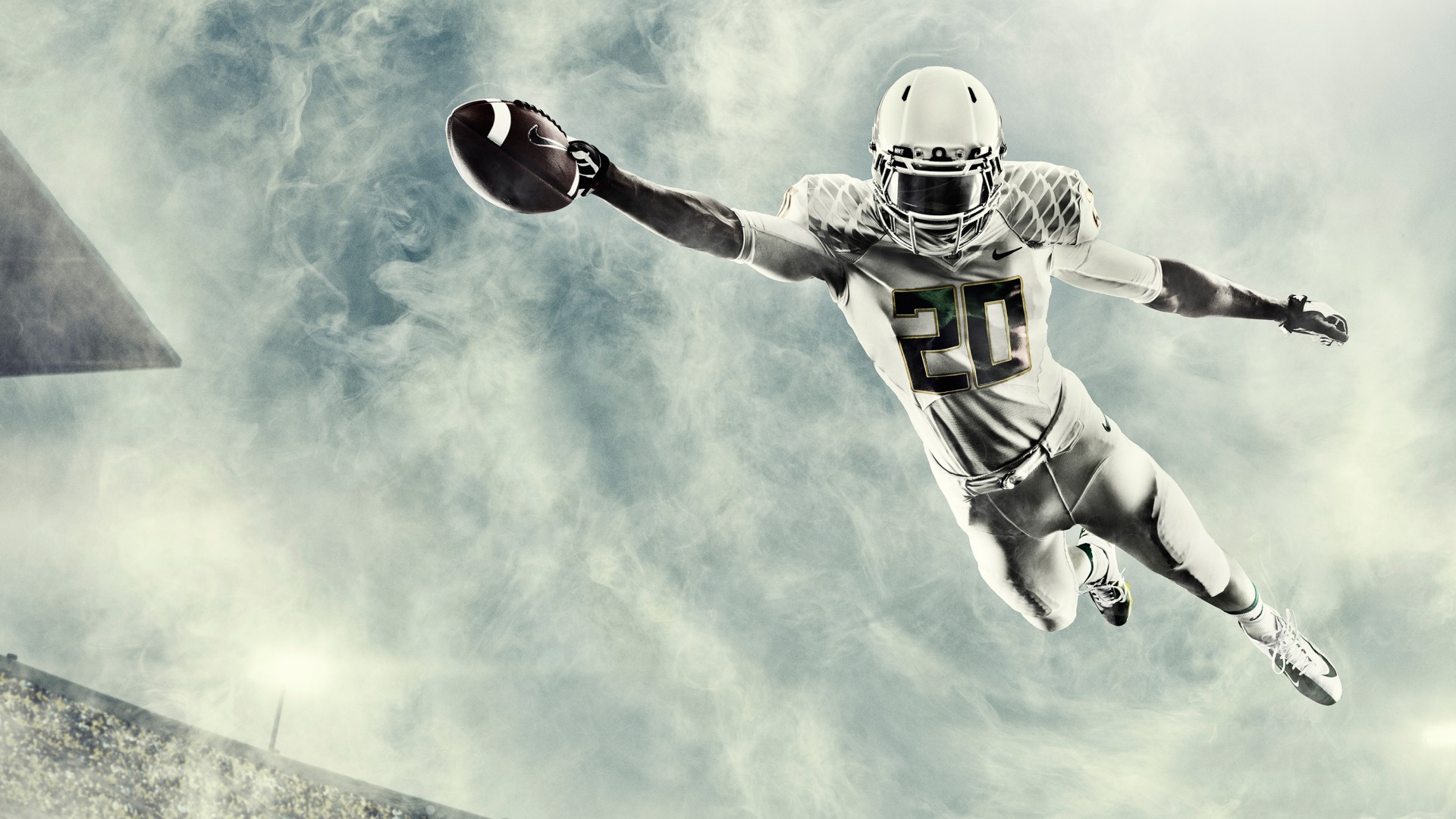
American football, referred to as football in the United States and Canada and also known as gridiron,[nb 1] is a team sport played by two teams of eleven players on a rectangular field with goalposts at each end. The offense, which is the team controlling the oval-shaped football, attempts to advance down the field by running with or passing the ball, while the defense, which is the team without control of the ball, aims to stop the offense’s advance and aims to take control of the ball for themselves. The offense must advance at least ten yards in four downs, or plays, and otherwise they turn over the football to the defense; if the offense succeeds in advancing ten yards or more, they are given a new set of four downs. Points are primarily scored by advancing the ball into the opposing team’s end zone for a touchdown or kicking the ball through the opponent’s goalposts for a field goal. The team with the most points at the end of a game wins.Charles Goodyear
The history of American football can be traced to early versions of rugby football and association football. Both games have their origin in varieties of football played in Britain in the mid-19th century, in which a football is kicked at a goal or kicked over a line, which in turn were based on the varieties of English public school football games. American football resulted from several major divergences from association football and rugby football, most notably the rule changes instituted by Walter Camp, a Yale University and Hopkins School graduate who is considered to be the “Father of American Football”. Among these important changes were the introduction of the line of scrimmage, of down-and-distance rules and of the legalization of blocking.[1][2][3] In the late 19th and early 20th centuries, gameplay developments by college coaches such as Eddie Cochems, Amos Alonzo Stagg, Parke H. Davis, Knute Rockne, and Glenn “Pop” Warner helped take advantage of the newly introduced forward pass. The popularity of college football grew as it became the dominant version of the sport in the United States for the first half of the 20th century. Bowl games, a college football tradition, attracted a national audience for college teams. Boosted by fierce rivalries and colorful traditions, college football still holds widespread appeal in the United States. The origin of professional football can be traced back to 1892, with William “Pudge” Heffelfinger’s $500 contract to play in a game for the Allegheny Athletic Association against the Pittsburgh Athletic Club. In 1920 the American Professional Football Association was formed. This league changed its name to the National Football League (NFL) two years later, and eventually became the major league of American football. Primarily a sport of Midwestern industrial towns in the United States, professional football eventually became a national phenomenon.
The man most responsible for the transition from this rugby-like game to the sport of football we know today was Walter Camp, known as the “Father of AmericanFootball.” As a Yale undergraduate and medical student from 1876 to 1881, he played halfback and served as team captain, equivalent to head coach at the time.

 JOSHUA'BLOG